24 Hours in Udawalawe — Real Jeep Safari Trip Report
Our honest, hour-by-hour trip report on 24 hours in Udawalawe: dawn safari, sunset safari, real costs and timings, and the moments most guides leave out.
Shashika Sandaruwan
Tour Guide and tour article writer with 10 years of field experience
The alarm goes off at 4:45 AM, and for a second you forget where you are. Then you hear it: a rooster somewhere past the tree line, then something heavier moving through the grass nearby, and it comes back — you’re in Udawalawe, and the jeep leaves in twenty minutes.
This is our honest, hour-by-hour account of 24 hours in Udawalawe — not a “top things to do” list stitched together from other blogs, but what actually happened on one real trip, start to finish. Evening arrival, a pre-dawn wake-up call, two full safari drives, a stop at the Elephant Transit Home, and a night with more stars than we’d seen in years.
If you’re planning your own 24 hours in Udawalawe and want to know what the timings, the costs, and the actual experience look like before you book, here’s exactly how our day went — including the parts that don’t usually make it into the brochure.
The Evening Before: Arriving in Udawalawe
Most visitors reach Udawalawe from Colombo, Ella, or the south coast, and the drive takes roughly three to four hours depending on where you start. We arrived just after 5 PM, with enough daylight left to check into a small guesthouse a few minutes from the park’s main entrance and watch the sky turn orange over the tea and paddy fields on the way in.
Dinner was simple — rice and curry, a pot of Ceylon tea — and our driver-guide, a local who grew up in the area, ran through the plan for the next 24 hours in Udawalawe: gates open at 6:00 AM sharp, so we’d need to leave by 5:30 AM to be in line. Then he said the thing every guide says and every guest ignores at their peril: “Sleep now. Tomorrow starts early.” Outside, the sound of the wild made that easier said than done.
4:45 AM: The Wake-Up Call
The alarm felt personal. Coffee happened fast, gear got checked twice — camera battery, memory card, and yes, the 150mm-plus zoom lens every guide in Udawalawe will tell you to bring, because elephants don’t pose close to the track on request.
By 5:15 AM we were in the jeep, headlights the only light on the access road, and by 5:40 AM we were parked at the gate behind four other vehicles, all waiting for the same 6:00 AM opening. It didn’t feel like a queue so much as a shared understanding: everyone here wanted the same quiet, cool hour before the park woke up properly.
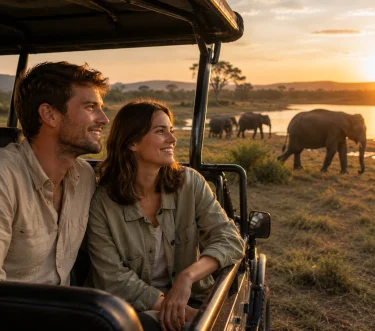
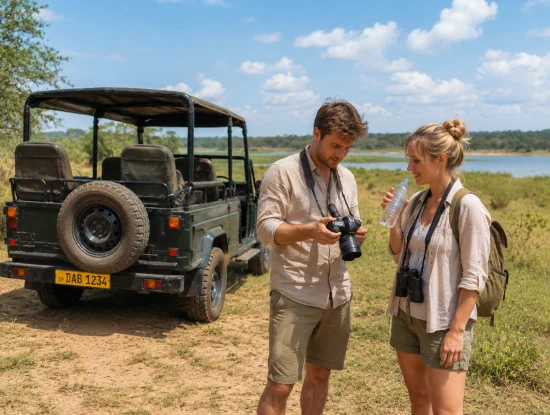
4:45 AM — leaving for the gate before the 6 AM opening.
Dawn Safari: Udawalawe’s Cool, Quiet Awakening (6:00–9:30 AM)
The gate opened right on time, and the first twenty minutes were almost eerie — headlights cutting through mist over open grassland, the air cool enough for a light jacket, no elephants in sight yet. Then, at 6:15 AM, our driver cut the engine without a word and pointed.
A single bull elephant, maybe thirty metres off the track, tearing grass in the half-light. Our first sighting of the day, and far from our last — this is one of the reasons a morning safari consistently delivers some of the highest elephant sighting odds in Udawalawe, often well above 90%.
6:15 AM — our first elephant sighting of the day, just after the gates opened.
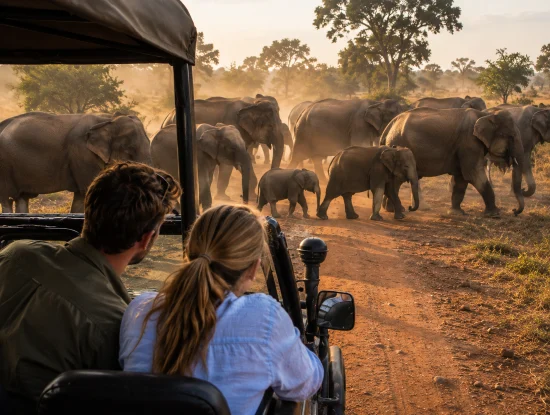
Over the next two hours, the park properly woke up around us. A family herd crossed the track close enough that our driver put the jeep in park and waited, calves tucked between the adults, in no hurry at all. Painted storks worked the shallows near the reservoir. A monitor lizard the length of our jeep’s wheelbase sat motionless on a rock. Water buffalo watched us watch them.
A family herd crosses right in front of our jeep during the morning safari.
By 9:30 AM the light had gone from soft gold to flat and bright, and the animals were drifting toward shade — our cue, along with the rising heat, that the morning half of our 24 hours in Udawalawe was winding down.
Midday: The Elephant Transit Home and Downtime (10 AM–2 PM)
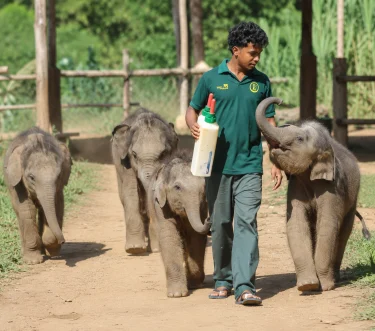
Instead of heading straight back to rest, we used the midday lull for something most single-safari visitors skip entirely: a stop at the Udawalawe Elephant Transit Home, a short drive from the park entrance. Tickets are inexpensive — a few dollars per adult, paid at the gate, no booking required — and one of the early-afternoon feeding sessions was starting as we arrived: dozens of orphaned calves jogging down to the feeding line for their bottles, a very different, very hands-off kind of elephant encounter compared to the wild sightings that morning.
Back at the guesthouse by early afternoon, we did what every experienced guide recommends and most first-timers underestimate: nothing. Lunch, a shower, a nap in the shade. Udawalawe’s wildlife spends the hottest hours resting too, and a jeep safari between roughly 11 AM and 2 PM tends to be the quietest, least rewarding window of the day — better spent recovering for round two.
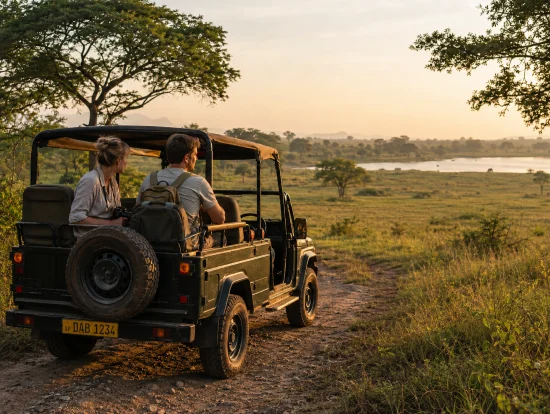
The midday lull — resting up before the sunset safari.
By 2 PM we were back in the jeep, refuelled and, frankly, glad of the break.
Sunset Safari: Golden Hour at the Reservoir (2:30–6:00 PM)
Afternoon safaris in Udawalawe typically start around 2:30 to 3:00 PM, and the first hour can feel slow — most of the wildlife is still shaking off the midday heat. We saw comparatively little for the first forty minutes: a few deer, a distant herd resting in tree shade, more patience required than the morning drive.
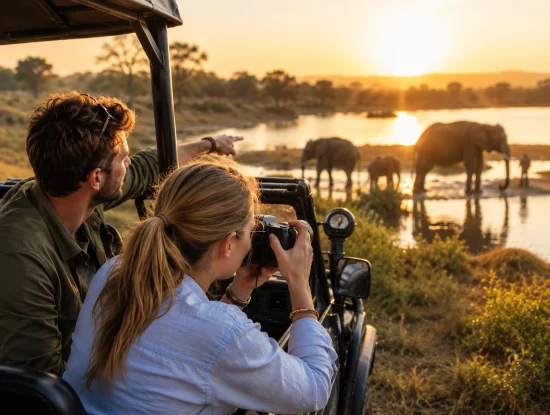
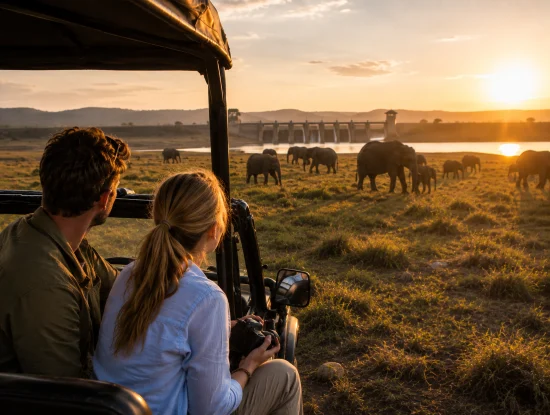
Then, as the heat broke, everything changed. Herds began moving back out toward the Udawalawe Reservoir to drink and bathe, and by 4:30 PM we were watching a family group wade into the water with the dam wall and the hills behind them turning gold. This, more than the dawn sightings, was the moment that made the two-safari version of 24 hours in Udawalawe worth it — the light alone was worth the whole day.
Elephants gather at the Udawalawe Reservoir as the light turns gold.
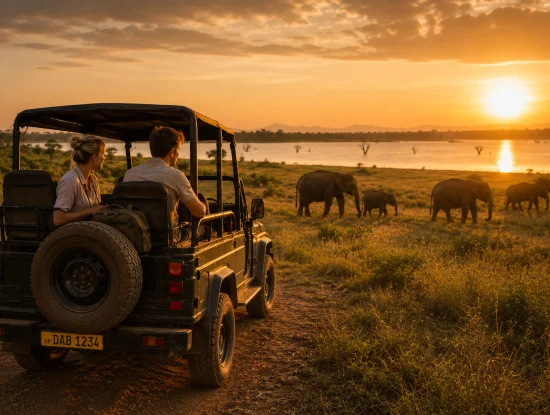
Closer to 5:30 PM, with the sun dropping fast, our jeep idled beside a lone bull just fifteen metres off the track, backlit and completely unbothered by us. Nobody in the jeep said anything for a full minute. Then, right on schedule, our driver started the engine — gates close at 6:00 PM sharp, and Udawalawe’s rangers are not flexible about it.
A close, quiet encounter in the last light before the gates close at 6 PM.
Night: Dinner, Stars, and What 24 Hours Actually Taught Us
Dinner that night felt different from the one before it — less nervous anticipation, more replaying favourite moments over rice and curry. With almost no light pollution near the park boundary, the sky after dark was worth stepping outside for on its own: more stars than most of us had seen in years, and somewhere in the dark beyond the guesthouse fence, the same insect chorus that had kept us half-awake the night before, now oddly comforting.
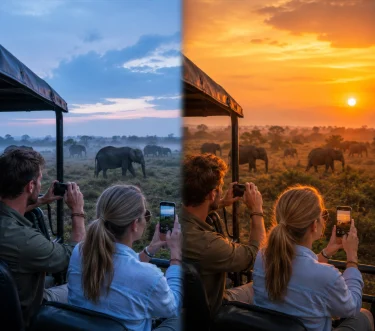
If there’s one thing 24 hours in Udawalawe taught us, it’s that the morning-versus-sunset safari debate is a false choice when you actually have the time. The dawn drive gave us the highest odds and the coolest, quietest hours; the sunset drive gave us the best light and the most dramatic single moment of the day, at the reservoir. Doing both, in one loop, is what turned a good safari into a genuinely complete one.
What a Real 24 Hours in Udawalawe Costs
Prices in Sri Lanka’s national parks are set by the Department of Wildlife Conservation and get revised periodically, so treat these as a realistic 2026 ballpark rather than a fixed quote — always confirm current rates before you book.
Item
Approximate Cost
Private jeep safari (morning or sunset, per jeep, group pricing)
From ~$42 USD
Two safaris in one day (dawn + sunset)
From ~$75–85 USD per jeep
Udawalawe Elephant Transit Home entrance (foreign adult)
~$5–6 USD
Budget guesthouse near the park (double room, per night)
~$25–35 USD
Simple local meal (rice and curry)
~$3–5 USD
Split across two or three people sharing a jeep, a full 24 hours in Udawalawe — two safaris, a night’s stay, the Elephant Transit Home, and meals — comfortably fits a modest travel budget. For current jeep availability, see our Udawalawe safari packages.
Practical Tips for Your Own 24 Hours in Udawalawe
Book your jeep the day before, especially in peak season (Dec–Mar and Jul–Aug); good driver-guides fill up fast.
Bring a light jacket for the dawn drive — 22–25°C at 6 AM feels colder than it sounds in an open jeep.
Pack a zoom lens if you’re serious about photos; 150mm or longer makes a real difference at a respectful distance.
Carry small denominations of cash for park tickets, the Elephant Transit Home, and roadside stops — cards are rarely accepted at the gate.
Visit in the dry season (roughly May–September) for easier tracks and more predictable sightings around the reservoir.
Do both safaris if your schedule allows it; the morning and sunset drives genuinely offer different experiences, not just repeats of each other.
Keep a respectful distance from elephants at all times, and always follow your driver-guide’s instructions — Udawalawe’s animals are wild, not tame.
Frequently Asked Questions
Is 24 hours enough time in Udawalawe?
Yes. A single 24-hour visit — one evening, a dawn safari, a midday break, and a sunset safari — is enough to see elephants reliably in both settings and experience the park’s two very different daily rhythms, without needing multiple days.
Should I choose a morning or sunset safari in Udawalawe?
Both have real advantages: mornings tend to have slightly higher elephant sighting odds and the most bird activity, while sunset safaris offer the best light for photography and a dramatic finish at the Udawalawe Reservoir. Our morning vs sunset safari comparison breaks down the differences in detail — if your schedule allows it, doing both in the same 24 hours, like we did, is the best of both.
How much does a Udawalawe jeep safari cost?
A private jeep safari in Udawalawe typically starts from around $42 USD per jeep on a group-pricing basis, with two safaris in one day (dawn and sunset) coming in from roughly $75–85 USD per jeep, before accommodation, park tickets, and meals.
Do I need to book a safari jeep in advance?
It’s not always required, but booking the day before is strongly recommended, especially during peak season, since experienced local driver-guides and well-maintained jeeps are limited and fill up quickly.
Can I combine a Udawalawe safari with the Elephant Transit Home in one day?
Yes, easily. The Elephant Transit Home is only a short drive from the park entrance, and its early-afternoon feeding sessions fit naturally into the midday break between a morning and sunset safari, exactly as we did during our 24 hours in Udawalawe.
Ready to plan your own 24 hours in Udawalawe? Our local driver-guides know exactly where the herds move at dawn and where the light falls best at sunset — get in touch to book a private jeep safari and build a full day and night around it, just like this one.
Experience Udawalawe National Park with our exclusive safari packages! Choose from 4, 7, or 10-hour tours, guided by experts, and explore Sri Lanka’s incredible wildlife up close in a private 4×4 jeep.