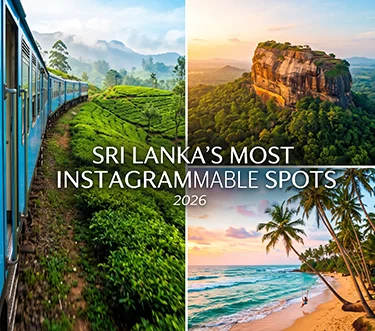
Ten Instagram-worthy spots in Sri Lanka for 2026, from golden-grass elephants to the Nine Arches Bridge and Coconut Tree Hill. Where to go, and when to shoot.
Shashika Sandaruwan
Tour Guide and tour article writer with 10 years of field experience
Our drivers see it happen almost every week. A guest steps out of the car, phone or camera already in hand, and stops mid-sentence because the view in front of them doesn’t match anything they rehearsed for. Sri Lanka does that to people. It’s a small island, but these ten Instagram-worthy spots in Sri Lanka cover almost every kind of shot a traveler chases: wildlife at eye level, a bridge that seems to float over a valley, tea rows that go on longer than your battery life, and a beach swing that’s launched a thousand feeds.
This isn’t a ranked list. It’s closer to a route, the kind our drivers actually take guests on between the hill country, the south coast, and the east. Wherever you start, pack an early alarm. Nearly everything here looks better in the first or last hour of daylight, and worse under the flat glare of midday.
1. Udawalawe National Park: an elephant safari in the golden grass
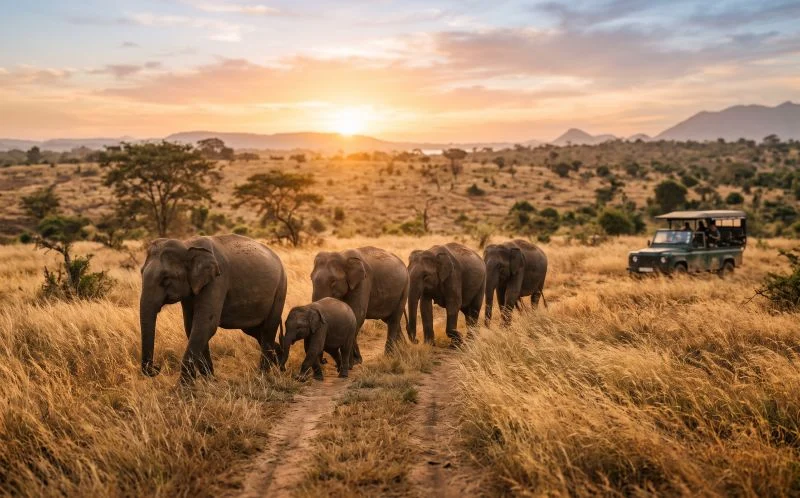
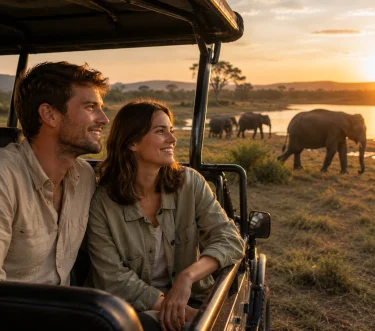
Udawalawe doesn’t hide its elephants in dense jungle the way some parks do. The park spreads across roughly 30,800 hectares of open grassland around the Udawalawe reservoir, and that openness is exactly what makes the photography here different. Herds move across wide plains in full view, and when the late afternoon sun drops low, the dry-season grass turns the kind of gold that makes a phone camera look professional. Around 250 elephants live in the park, alongside water buffalo, sambar deer, crocodiles, and occasionally a leopard for those with patience and luck.
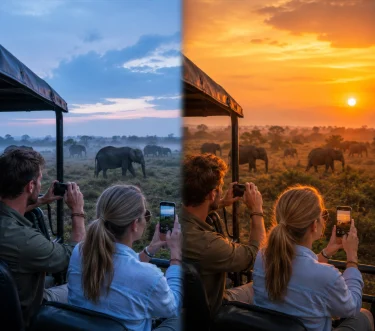
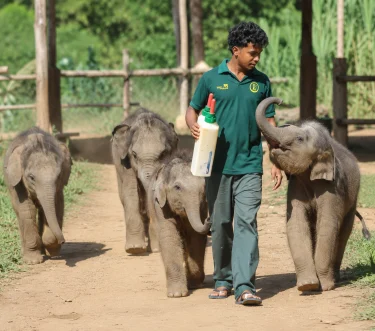
Morning safaris (around 6 a.m.) usually mean cooler air and more active animals, while the late-afternoon drive is the one photographers request by name for that golden-grass look. If babies and close encounters are the goal rather than a safari drive, the Udawalawe Elephant Transit Home next door lets you watch orphaned calves feed from just a few meters away.
Good to know: best light is 6-7 a.m. or 4:30-6 p.m.; the park is roughly 165 km (about 3.5 hours) from Colombo. Our full Udawalawe safari guide covers timings, permits, and what to expect on your first drive.
2. Ella: the Nine Arches Bridge
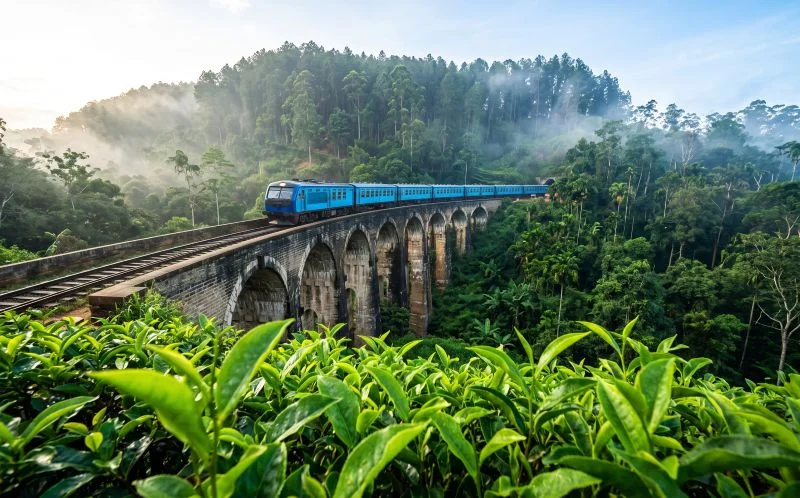
Nine curved arches, no steel reinforcement, built by local labor under British supervision and finished in 1919, the Nine Arches Bridge still carries the Kandy-Badulla railway line through a patch of jungle outside Ella. It’s the shot everyone already knows before they arrive: a blue-and-red train easing across pale stone arches with tea slopes behind it. What the photos rarely show is the walk in, a short trail past a couple of cafés that have figured out exactly how to time a coffee with the 9:30 a.m. or 11:40 a.m. train.
You don’t need to be on the train to get the picture. Most visitors climb one of the surrounding viewpoints, wait out the between-train quiet, and let the jungle noise fill in the gap. If you’re arriving by road rather than rail, our Ella transfer route connects the town with Udawalawe for travelers linking the hill country to a safari.
Good to know: check the current train timetable before you go, since schedules shift; arrive at least 20 minutes before a scheduled train for a clear spot.
3. The Kandy to Ella route: a train ride that outshines the view
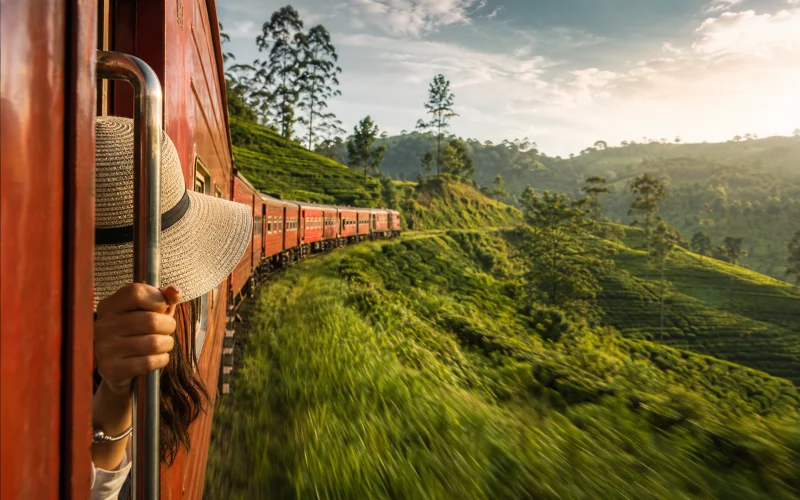
Some journeys exist mainly to get you somewhere. This one is the destination. The line between Kandy and Ella climbs through tea estates, tunnels, and mist that rolls across the valleys without warning, and more than one travel writer has called it one of the most scenic rail journeys anywhere. The best photographs rarely come from a phone held out a window; they come from standing in the open doorway between carriages, which is technically discouraged and practically how almost everyone does it.
Reserved second-class seats near the window sell out weeks ahead in high season, so book early or plan to stand for the best stretch, between Nanu Oya and Ella. If a fixed train schedule doesn’t suit your itinerary, our Kandy to Udawalawe route covers the same hill-country scenery by private car, with stops wherever you want them.
Good to know: the journey from Kandy to Ella takes around 6-7 hours by train; book tickets in advance during the December to March high season.
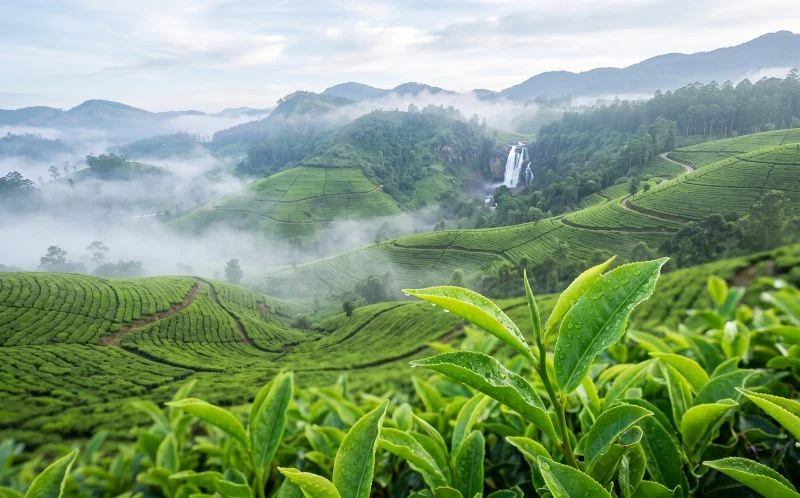
4. Nuwara Eliya: rolling green tea estates
At 1,868 meters above sea level, Nuwara Eliya sits high enough that the temperature drops and the light turns soft and diffused, which happens to be exactly what tea-row photography needs. Locals still call it “Little England” for its colonial-era architecture and cool, damp mornings, but the real draw for a camera is the geometry: rows of tea bushes trimmed into curves that follow the hillside, dotted with pickers in bright saris against all that green.
Estates like Pedro or Mackwoods welcome visitors for factory tours, and the surrounding roads offer viewpoints where you can shoot the terraces without walking onto private plantation land. Come dressed for genuinely cool weather; this is one part of Sri Lanka where a jacket earns its space in the bag. Our Nuwara Eliya route links the tea country to Udawalawe for anyone combining hill-country views with a safari.
Good to know: mornings bring the clearest air and softest light before afternoon mist sets in; expect cooler temperatures than anywhere else on this list.
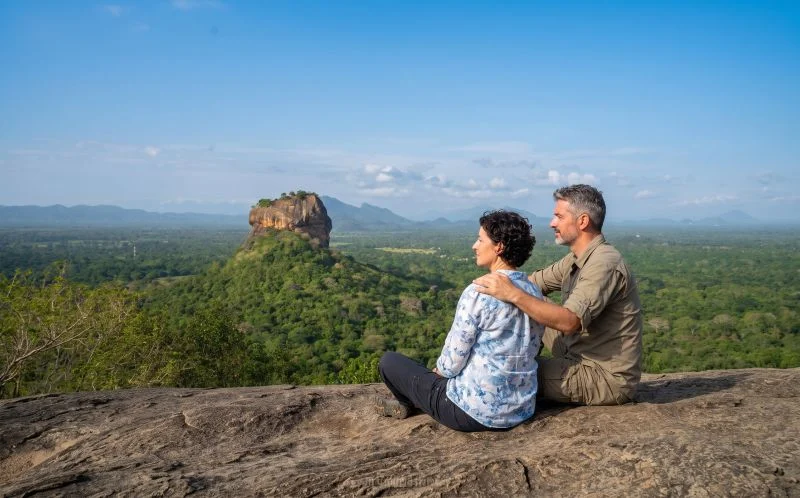
5. Pidurangala Rock: looking out toward Sigiriya
Everyone photographs Sigiriya Rock. Fewer people realize the better photograph is taken from a kilometer away, looking back at it. Pidurangala rises about 200 meters above the surrounding jungle, and the climb to its summit, roughly 30 minutes to the reclining Buddha and a short scramble beyond, ends on a flat granite platform with an open, 360-degree view. From there, Sigiriya’s sheer walls catch the first light of sunrise while mist still sits in the forest below, which is the picture worth setting an alarm for.
It’s also considerably less crowded than the summit of Sigiriya itself, so there’s room to actually compose a shot instead of waiting in a queue for it. If you’re coming from the airport or elsewhere in the Cultural Triangle, our Sigiriya transfer route gets you there before sunrise crowds build.
Good to know: arrive by 5:15-5:30 a.m. for sunrise; bring a headlamp for the dark start of the trail.
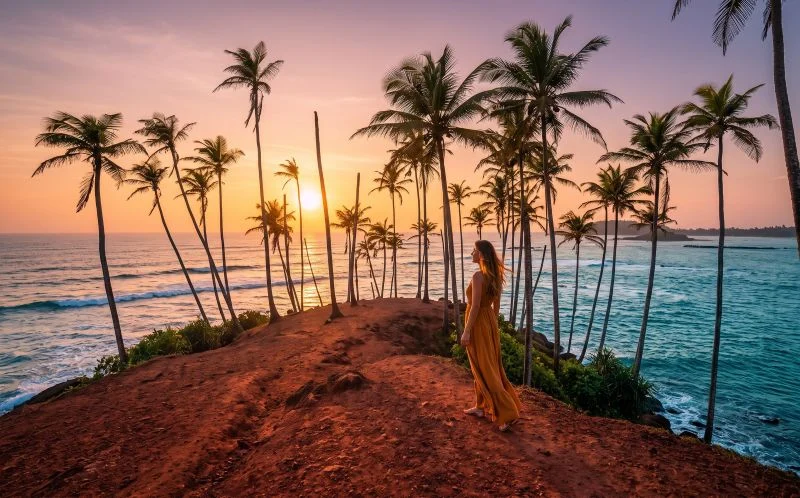
6. Mirissa: Coconut Tree Hill
A curve of coconut palms leaning out over a headland, with the Indian Ocean stretching out behind them: Coconut Tree Hill near Mirissa is a small piece of land that has done a disproportionate amount of work for Sri Lanka’s tourism image. It’s a five-minute walk from the road, free to visit, and busiest at sunrise and sunset when the low light turns the palm trunks into silhouettes.
Mirissa itself is worth building a morning around beyond this one viewpoint. Blue and sperm whales pass offshore between November and April, and boats head out early to catch calmer seas before the wind picks up. Between the whale watching, the beach, and the palm-hill photo, it’s easy to lose a full day here without noticing. Heading onward or arriving via Udawalawe, our Mirissa route connects the two directly.
Good to know: sunrise and sunset both work here; whale watching season runs roughly November through April.
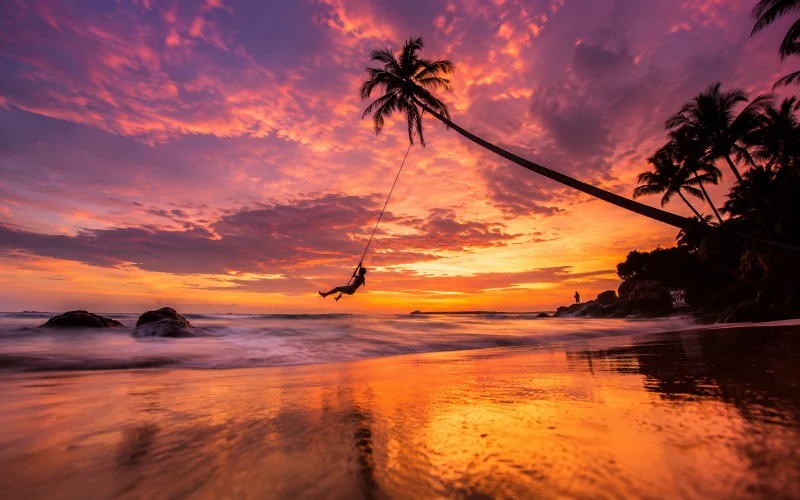
7. Dalawella Beach: the palm tree rope swing
There’s one photograph nearly every visitor to the south coast tries to recreate: a rope swing hanging from a leaning palm tree, someone mid-arc over turquoise water. That’s Dalawella, a short stretch of beach near Unawatuna where a couple of beachfront cafés maintain the swing (and charge a small fee to use it, which goes toward its upkeep). Morning light works best, both because the beach is quieter and because the water hasn’t yet caught the midday glare.
It’s a five-minute stop, honestly, but a popular one, so patience helps if there’s a short queue for the swing itself. The wider stretch of coast between Galle, Unawatuna, and Weligama rewards slower travel, and our Weligama route covers this same coastline for anyone continuing toward Udawalawe.
Good to know: go early (before 9 a.m.) to beat both the crowd and the harsh midday sun; there’s usually a small charge to use the swing.
8. Galle Fort: the lighthouse and cobblestone streets
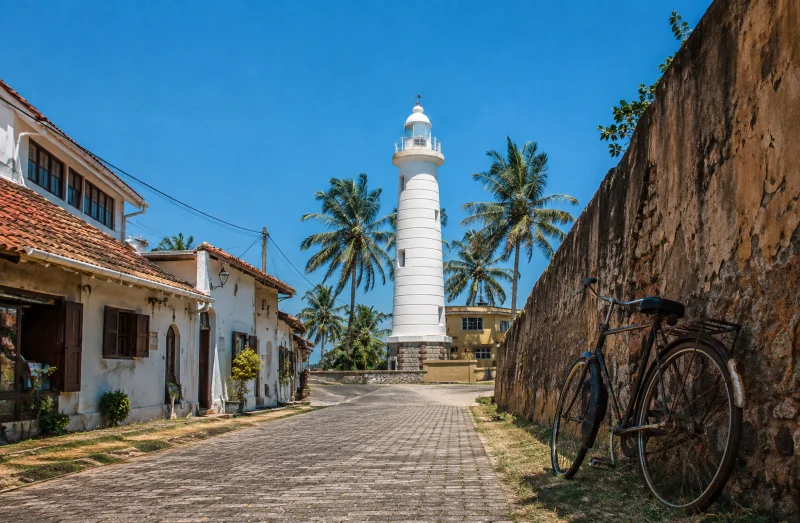
Galle Fort has been standing, in one form or another, since the Portuguese first built fortifications here in 1588. The Dutch expanded it through the 17th century, adding the ramparts and bastions that still ring the old town, and UNESCO recognized the whole fort as a World Heritage Site in 1988. Walk the walls at golden hour and you get the ocean on one side and red-tiled colonial rooftops on the other. The lighthouse at Point Utrecht Bastion, rebuilt in 1938 after fire destroyed the original, is the postcard shot, but the narrow cobblestone streets behind it are where the fort’s actual character shows up: converted Dutch townhouses, small galleries, and cafés tucked into 300-year-old walls.
Come for sunset on the ramparts, then stay for an hour and wander inland into the grid of streets while the light fades. Our Galle route connects the fort to Udawalawe for travelers working their way along the south coast.
Good to know: the ramparts are busiest at sunset; the streets inside the fort are quieter and better for photos in the hour beforehand.
9. Koggala: traditional stilt fishermen
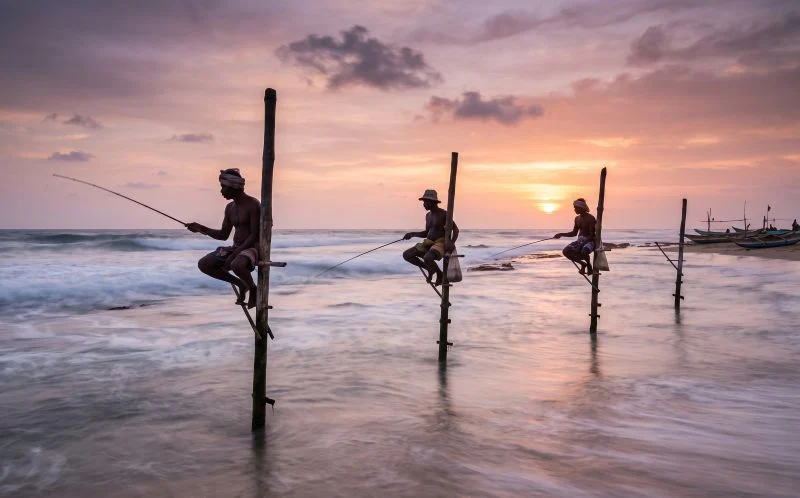
The image is instantly recognizable: a fisherman balanced on a single wooden pole driven into the shallows, silhouetted against the sea. What most photos leave out is the story behind it. Stilt fishing, known locally as ritipanna, began during World War II, when food shortages and crowded shorelines pushed fishermen to improvise perches above the water, first using shipwreck debris, later purpose-built stilts. Today the fish stocks near shore rarely justify the effort, so most of the men you’ll see posing at sunset are performers who rent a stilt for the afternoon rather than working fishermen. It’s worth knowing before you go, and worth paying them directly if you take their photo; it’s effectively their livelihood now.
The stretch of coast around Koggala and neighboring Ahangama is also where a lot of Sri Lanka’s newer surf culture has taken root, so it pairs naturally with a longer south-coast stop. Our Ahangama route covers this part of the coastline en route to Udawalawe.
Good to know: sunset gives the strongest silhouettes; a small tip or fee is expected if you photograph the fishermen.
10. Arugam Bay: surfing and coastal culture
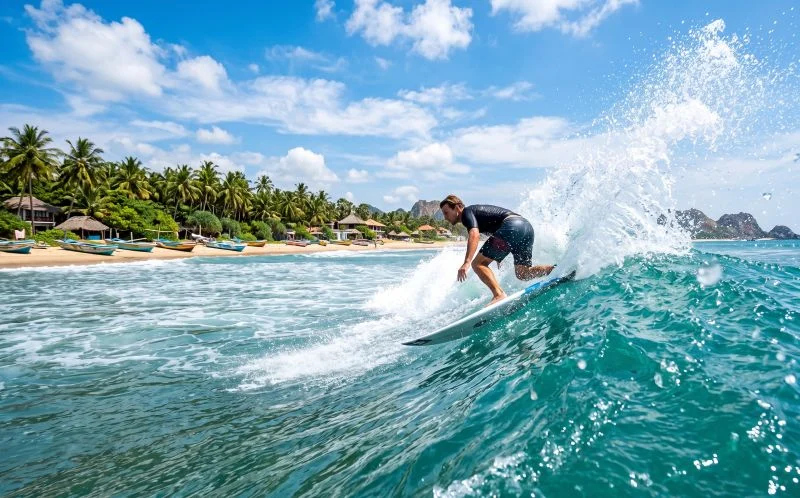
Arugam Bay runs on a different clock than the rest of this list, both literally and in terms of season. The east coast’s dry months, roughly April through September, are when the swell lines up and Main Point, the bay’s signature right-hand break, produces rides that can stretch past 400 meters. Photographers cluster on the rocks near the point at sunrise, when the light comes in low and gold over the water and the lineup is still thin.
Beyond the surf, Arugam Bay has its own unhurried, salt-worn character: driftwood cafés, lagoon boat trips to spot elephants near Panama, and a pace that feels distinctly different from the more manicured south coast. If you’re building a longer east-coast leg into your trip, it pairs well with a stop at Yala; our Yala to Udawalawe transfer can help connect the two.
Good to know: surf season runs roughly April to September; sunrise offers the calmest wind and best light on the water.
Stitching these Instagram-worthy spots in Sri Lanka into one trip
None of these places sit right next to each other, which is really the point. Sri Lanka’s size is deceptive; a single week can realistically move you from wildlife in the dry lowlands to hill-country tea terraces to warm south-coast water, provided the transport between them doesn’t eat the whole day. That’s the part guests ask us about most: not which spots to see, but how to move between them without losing a morning to bus schedules or a missed train.
A private driver solves most of that. You can chase sunrise at Pidurangala, nap through the transfer, and still make it to a Udawalawe evening safari the same day. Our private driver routes across Sri Lanka cover most combinations of the spots above, and if you’d rather see the island’s other side too, our guide to Sri Lanka’s top tourist attractions rounds out the list with a few places that didn’t make this one.
Frequently asked questions
What is the most Instagram-worthy place in Sri Lanka?
There isn’t a single answer, since it depends on what you’re after. For wildlife, it’s Udawalawe National Park at golden hour. For the single most-recreated shot on the island, it’s the palm tree swing at Dalawella Beach or Coconut Tree Hill in Mirissa.
What is the best time of year to visit Sri Lanka for photography?
It depends on the coast. The south and west coasts (Mirissa, Galle, Dalawella) are driest from December to March, the hill country (Ella, Nuwara Eliya) is pleasant most of the year but clearest in the early morning, and the east coast (Arugam Bay) has its dry, sunny season from April to September.
Can you visit all ten of these spots in one trip?
Yes, though it takes planning. A two-week itinerary with a private driver can realistically cover all ten, moving between the Cultural Triangle, hill country, south coast, and east coast without the delays of public transport. Shorter trips usually mean choosing one or two regions rather than the whole loop.
Is Udawalawe or Yala better for elephant photos?
Udawalawe is generally the more reliable choice for elephants specifically, since its open grassland means fewer places for a herd to disappear into. Yala has a broader range of wildlife, including a higher chance of leopard sightings. Our comparison of Udawalawe versus Yala safari breaks down the difference in more detail.
Do I need a permit to fly a drone in Sri Lanka?
Drone use in Sri Lanka is regulated, and rules around registration and no-fly zones (including near Sigiriya, airports, and some national parks) do change from time to time. Check the current requirements with the Civil Aviation Authority of Sri Lanka before you travel, since flying without the correct permission can mean a confiscated drone.
What’s the easiest way to get between these locations?
A private driver is the most flexible option for a route like this, since it removes the need to plan around train and bus timetables. Our taxi and driver services cover transfers to and from Udawalawe and can be arranged to link several of these stops in a single itinerary.
Ten Instagram-worthy spots in Sri Lanka, ten very different kinds of light. Bring a spare memory card.
Experience Udawalawe National Park with our exclusive safari packages! Choose from 4, 7, or 10-hour tours, guided by experts, and explore Sri Lanka’s incredible wildlife up close in a private 4×4 jeep.